Sample chapters – read before you buy
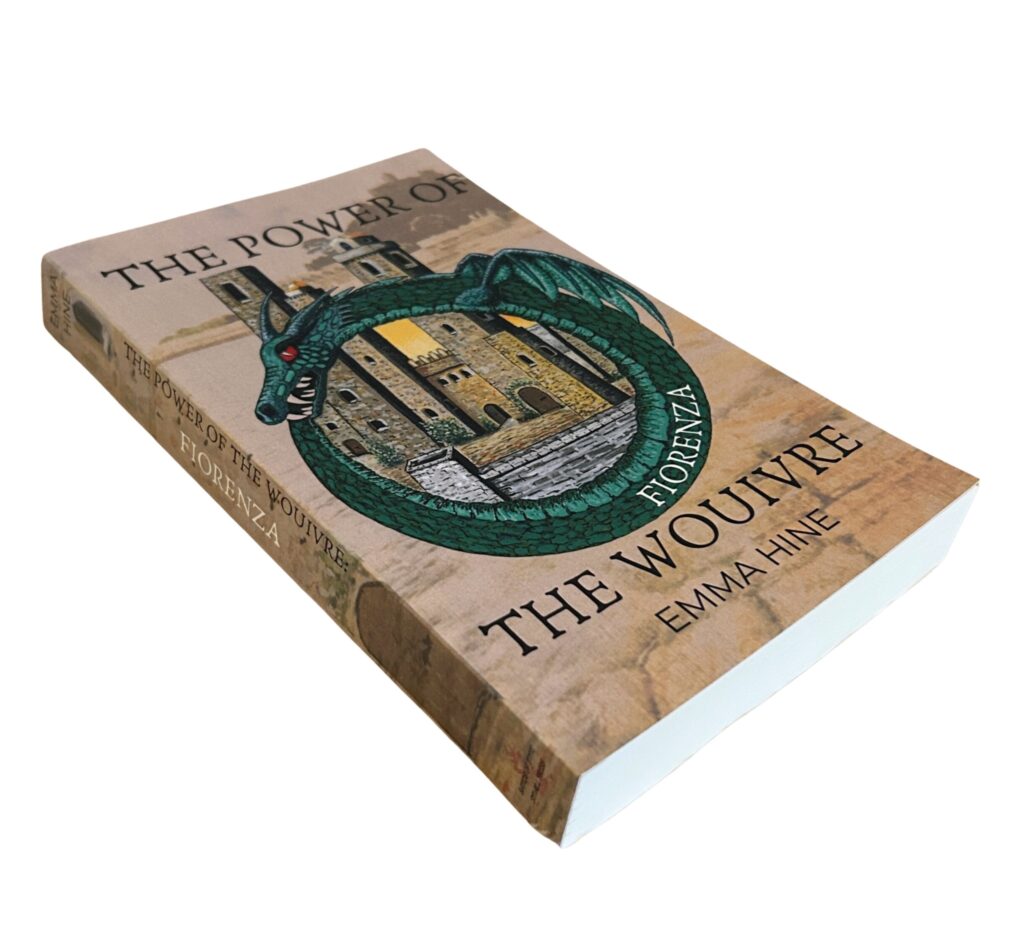
The Power of the Wouivre: Fiorenza
Chapter 1
The rivalry between Siena and Fiorenza went beyond what you or I could imagine. It was gang warfare of the most medieval, primitive kind. When it came to matters of politics or economics, violence was the main currency. Even within each town, factional riots were commonplace, revenge was everything, and men constantly challenged one another to duel to the death.
In the San Martino district of Siena, our hero starts his journey. His name is Guidaloste degli Orzotti. He is eighteen years old and a noble gentleman, although he does not know this yet. But let us start at the beginning.
Despite the grisliness of the era, Guidaloste’s world was relatively straightforward. He was brought up Guidaloste Angelieri, the eldest son of a rich Sienese merchant banker. As international trade soared, so too did the lending and changing of money. Being a clever man, Guidaloste’s father, Angeliero, profited greatly from this commercial revolution, and to show for their wealth, the family lived in a substantial palazzo. However, the eighteen-year-old had always felt alienated from his younger siblings. While his two brothers had followed his father into the world of banking, Guidaloste had been sent to the house of a notable local knight to become a squire. It was his mother, Matilda, who had enabled this, although Guidaloste had never understood why, or how she had managed to persuade his father.
Nevertheless, Guidaloste had been happy enough to go along with her wishes; certainly, the idea of cavalry service was more appealing than monotonous days spent behind the counter of some vast bank. Knighthood had a thrill that counting change every day, like his brothers, did not. He was aware that they looked down on him for turning his back on the family profession, but he wasn’t concerned with them. It was enough that he knew who he was, and if his mother wished for him to spend more time training to ride and fight, then he would comply. He had always shared a special bond with her that the others did not have.
Then, on his eighteenth birthday in the year of our Lord 1278, his simple life was turned upside down. It was the fourth day of the month of September. The day when, eighteen years prior, from the top of the hill at Montaperti, beside the banks of the River Arbia, the then-Ghibelline Sienese had beaten the Guelph Fiorentines in an epic victory. Guidaloste could still remember, at his second or third birthday, being overjoyed that the whole city had organised such a wonderful street party just for him. Of course, he had been told the real reason for the celebrations afterwards.
What Guidaloste heard, however, when he got home on his eighteenth birthday, the echoes of the festivities still ringing in his ears, was to change his life forever.
‘Guidaloste, figlio,’ Angeliero said, drawing the curtain of his private chambers. ‘Son, I believe you are ready to take on the responsibilities of adulthood, and yet there is something you ought to know before I liberate you fully into adult life. I have postponed your emancipation hearing until seven full days hence, for I think you will need some time to take this in…’ Angeliero paused, struggling for the right words.
‘Yes, father?’ Guidaloste prompted gently, unaware of the shock he was about to receive. ‘What is it?’
‘Guidaloste, though it grieves me deeply to say this, it is time you found out the truth.’
Again, he paused, drawing in a long deep breath as though playing for time. Guidaloste waited patiently until his father finally continued.
‘I am not your real father, Guidaloste. Your real father – your blood father – was a man by the name of Buonaguida degli Orzotti, a gentleman of noble birth, killed in the Battle of Montaperti when he was just a few years older than you are now. Your mother was in her eighth month carrying you when she heard of his death and the news grieved her so greatly that it induced an early labour. As you know, you were born just minutes after the battle was won. Signor Buonaguida died in the final moments of the battle. A few more hours and he would have tasted sweet victory and been able to return home to his wife and his new-born son.’ He sighed. ‘I do not tell you this to alienate you, but rather, to allow that should you wish to take the family name of your ancestors and emancipate as an Orzotti, it shall be done.’
Guidaloste stared blankly, his mind a whirl. It was all too much. He felt physically sick. He vaguely heard the words now issuing from the lips of his father, who was not his father, but yet as close to a father as he had ever known.
‘There is one more thing. Your fa…’ Angeliero stopped mid-flow, unable to bring himself to use the word father. ‘Guidaloste,’ he finally murmured, ‘Signor Buonaguida was not of this town. He was an exile, a staunch Ghibelline cast out by his own town, the archenemy of the Sienese people. Figlio mio, Buonaguida degli Orzotti was a Fiorentine.’
Guidaloste reeled. A Fiorentine? His own father? How was that possible? His ancestors were probably still living in Fiorenza! A sudden realisation washed over him. ‘Then that makes me a Fiorentine, too, Papa.’
‘Half Fiorentine, yes, figlio mio, but your mother has always lived here, her family Sienese nobility from way back. And you, you were born and raised here, so by rights, you belong more to Siena than you ever will to Fiorenza.’
Guidaloste stood there in utter disbelief, the colour drained from his face. His throat was dry, his chest tight; it became harder to breath. He opened his mouth to say something, but no words came out, for there were no words to say. But in his mind, they shouted.
He, Guidaloste Angelieri, was a Fiorentine. Or should he say Guidaloste degli Orzotti? He no longer knew who he was. Everything he had ever known, everything he had ever believed in had crumbled in those few minutes. Through a haze, he vaguely noticed the face of the man he’d called father, his hard, ambitious features softened with pain. He reached out in comfort, but Guidaloste pulled away, suddenly numb.
‘I need to be on my own, Papa. I have much to think about.’ His voice came out cold and distant, making Angeliero flinch, but Guidaloste had to get out of that room.
It was now more relevant than ever that the Sienese and Fiorentine people were hated rivals.
A few days later, after he had had a little time to get his head around the whole situation, Guidaloste discussed it over dice with his close friend, Antonio.
‘Caspita! A true, blue-blooded nobleman, Gui? I always said there was something different about you.’
‘You always said I was strange,’ Guidaloste retorted, looking down at the dice he had just rolled. ‘Yes, two sixes. I win!’
‘Mah!’ Antonio shrugged. ‘Well, yes. Strange… posh… same thing really, isn’t it?’
Laughing, he picked up the dice and rolled.
Antonio was the joker of the regiment, able to find humour in almost any situation and constantly laughing at his own wit, even when nobody else did. It was impossible to take him seriously and even harder to stay miserable in his company.
They had bonded over a mutual dislike for their commanding officer when they had both joined Siena’s San Virgilio company two years previously and had remained firm friends ever since. Despite his sense of humour, Antonio was fiercely loyal.
‘Ha, ha, very droll,’ Guidaloste replied. ‘I am no posher than you.’
‘Well now, that’s debatable,’ replied Antonio good-humouredly. ‘You’ll certainly have to stop hanging around with a mere infantryman like me, now you know your true descent. A born and bred nobleman can’t be seen fraternising with the likes of us poor commoners. Oh, unlucky, a three, I believe that’s one to me,’ he interjected, with a sly grin, noticing the poor throw Guidaloste had made. A thought occurred to him. ‘I suppose your father didn’t leave you anything before they killed him?’
‘What is that supposed to mean, Toni? I told you he was in exile when he died – the Fiorentine Guelphs would have burned and destroyed all his property. Besides, I was not yet born, and he hardly would have expected to die.’
‘He was in battle, Guida; you always expect to die in battle.’
Guidaloste conceded that it was a good point.
‘Well anyway,’ Guidaloste went on, ‘I do not think that money is the issue here. I mean, my stepfather is hardly badly off, and he has not disowned me. No, I am just trying to come to terms with not being who I thought I was; that and the fact that I never knew, and never will know, my father.’
Antonio looked up then, the dice still unrolled in his hand.
‘Gui, things haven’t changed, and you haven’t changed either. You’re a little weirder than normal, maybe, un po’ più strano… But no, seriously, you’re still the same man you were before all this, and Angeliero will always be your father. You just have to decide how far you want to go with your true lineage. Remember, you don’t have to do anything. You could still just take the information, digest it, say thank you very much, and then walk away; continue your life as you always have. Your life, Guidaloste, it’s what you make it.’
‘How profound, Antonio, I do not recall ever seeing you so earnest. But how do you not see that it has changed? Everything has changed… Hurry up and roll, I am about to win the round.’
Antonio scowled and threw the dice. Then he added facetiously, ‘Well, in that case, must you just abandon everything you’ve known so far – your family, your life, your entire existence even?’
‘I, I am not sure… maybe,’ Guidaloste muttered thoughtfully.
‘Wh-a-at? I was joking. You can’t really be serious… can you?’ Antonio looked up in shock at Guidaloste.
‘Well, maybe not give up my entire existence, but I cannot just pretend this is not real.’ He thought for a moment, muttering, as if to himself, ‘I have always said I can do anything I set my mind to, and right now, my mind is set.’
‘That’s a first,’ retorted Antonio.
Guidaloste appeared not to have heard.
‘Thanks, Toni, you have helped more than you know.’
He stood up so suddenly that his stool wobbled on two legs for a couple of seconds before toppling over. Guidaloste ran off before it hit the ground, leaving Antonio sat there by himself, staring open-mouthed down the street.
‘Gui, come back! You owe me eighty-six denarii. GUIDALOSTE…’
But Guidaloste, racing home to find his stepfather, did not look back. For the first time, he understood why he had always felt like an outsider in his own home. He was an Orzotti, and he had to discover what that meant – whatever that entailed. The hardest part would be leaving his mother, but it was clear now what his special bond with her had really meant, and why she had done so much for him – all this time trying to be both mother and father. He would miss her most of all, but he had to do this. He had to find his roots.
Over a thousand miles, and more than half as many years away, St Michael’s Mount towered precariously above the English Channel. Half sliding down the rocks of the island, it stood like a shrine to man’s achievements against adversity.
In the village below, overshadowed by the imposing former monastery, a boy was celebrating his fourteenth birthday. For Thomas, however, the last year couldn’t have been any weirder and it didn’t seem like much to celebrate. It wasn’t that he wasn’t enjoying himself – he’d spent the morning surfing with his best mates, Paul and Jason, and now they were all back at his watching a movie. But he was struggling to focus on the film.
All year, he’d been having strange hallucinations, like flashbacks to a past life, even though he didn’t believe in all that stuff. At first, he’d brushed them off, but they weren’t going away. If anything, they were getting worse, and recently, he’d had a couple of episodes of bright lights flashing behind his eyes. No, not flashing, swirling. As if light could swirl! Then he’d had the most vivid daydreams of some dude called Guidaloste – he said it Gwee-da-lost-eh in his head. He was starting to think that maybe he was sick. What was it when you had hallucinations? Schiza, schizoph-something. He’d looked it up in his mum’s medical dictionary right after he’d found ‘migraine’ for flashing lights behind the eyes. Except he wasn’t having headaches.
Now today, despite it being his birthday, he’d been feeling increasingly unnerved. It had started when, having dropped Jason and Paul’s surf gear at their respective houses, they had taken the ferry over to his. As they’d disembarked in the island harbour and stepped over the tourist barrier towards the rear of the first row of houses, he’d had an unsettling feeling of being watched. But that was ridiculous. Despite its magnificence, the Mount couldn’t be more friendly and inviting. The idea of anything foreboding going on in his sleepy, Cornish village below the castle was laughable. And yet, there was something going on that he couldn’t put his finger on.
He glanced across at his two best friends. Paul had his hand in the popcorn and was staring at the screen with a vacant look on his face. Jason was stretched out beside him. On the TV, Leonardo DiCaprio’s face stared reassuringly out from a Thai beach.
There was a knock at the door. Thomas pressed pause on the remote as his mum came in holding a small gift.
‘A present from your godmother, Morvoren,’ she explained, handing it out to him.
‘Who?’
‘Your godmother,’ repeated his mum.
Thomas narrowed his eyes at his mum and shook his head almost imperceptibly. ‘Who’s my godmother?’
Jason sniggered. ‘You know. That weird old lady who showed up last year at your thirteenth birthday. She gave you something then, too.’
‘Oh yeah. That fridge magnet,’ piped up Paul. ‘It was quite cool but completely pointless.’
‘Wasn’t even a magnet,’ replied Jason. ‘Just some bit of pottery.’
‘Oh that.’ Thomas could barely remember. He didn’t even know where he’d put it. ‘Great! Don’t think I’ll rush to open this then.’
He laughed half-heartedly and with a flick of his wrist, the flat, blue-star-wrapped gift landed with a thud on the coffee table, unopened.
‘Don’t be ungrateful, Thomas,’ said his mum, though she didn’t sound convinced.
Without responding, Thomas hit play on the movie and vaguely heard the door click shut as his mum left the room.
As The Beach resumed, Thomas tried to picture his godmother in his head. He’d only met her a handful of times; maybe no more than two that he could recall. All he could picture was a little old lady with long silvery-grey hair. What stood out more in his mind was the memory of his mum almost falling over herself to accommodate her whilst snapping at Thomas and his dad. His dad had told him to ‘just keep out of the women’s way all day,’ which had been fine with him. He told himself it was a “man-thing,” which made him feel less babyish for being scared of an old lady. Because truth be known, he was sure that the overriding feeling in the house that day had been fear.
Is my godmother here now? Thomas wondered when she might have given the gift to his mum. Was that why he’d felt unnerved since arriving back on the Mount? He stared at the screen, trying to work out what was going on in the film, when another of those swirls of light hit his eyes.
Guidaloste was standing in a light, airy courtroom next to Angeliero. A galleried balcony overlooked the room but was less busy than usual as no crime had been committed today. The court painter sat in a corner sketching the scene. Beside him, the scribe recorded the proceedings. Bishop Bernardo di Boncio of Siena presided. He lifted his hands from the table in front of him and looked around the room.
‘Who presents this child for emancipation?’ he asked.
Angeliero stepped towards the table and raised his hand. The bishop turned his attention on him.
‘And you are, signor?’
‘Angeliero Angelieri, merchant banker of the house of Angelieri, monsignor,’ replied Angeliero, bowing. ‘And this is my son, Guidaloste.’
He tugged his son’s sleeve, prompting Guidaloste to step forward and bow awkwardly. Bishop Bernardo nodded in acknowledgement.
‘And you are ready to release this boy from your household without marriage or service to the church?’
‘For nine years, my son has served the Conte del Rovescio and the San Virgilio company of Siena; the latter of which he serves still. He has proved himself a worthy member of society.’ The bishop nodded approvingly. ‘There is, of course, the small issue of paternity.’
‘Ah, a bastard!’ roared the bishop with a knowing smile. ‘You are done with the boy, then?’
The court erupted into raucous laughter.
‘My lord misunderstands.’ Guidaloste shuffled nervously as his father explained. ‘The boy was conceived in wedlock before I met my wife. She was widowed by the Battle of Montaperti. My wife has never been anything but virtuous and good.’
The bishop surveyed the pair. ‘So, what is the issue?’
‘Monsignor, my son has chosen to emancipate with his blood father’s name, to honour him, as he has honoured me these past eighteen years by taking mine. And I have agreed his request, with your excellency’s permission.’
There was much muttering as the bishop, magistrates and their notaries conferred.
After what seemed like an agonising wait, the bishop held up a hand for silence.
‘We have decided to grant this request. Please tell the court the new name.’
‘Orzotti, monsignor.’
So there, in front of the bishop of Siena, and a handful of witnesses, Guidaloste Angelieri became Guidaloste degli Orzotti. His father gave him, by way of a dowry, six hundred and fifty gold florins and one of his properties, a smallholding a few miles north-west of Siena. To the casual observer, little but his name had changed, but beneath the surface, a strong current was lurking, ready to pull him along on the crest of the wave that had already started to swell. The seeds had been planted, but the idea still needed time to grow. And then the dreams started.
Thomas jolted. It had happened again. For the rest of the film, he focused hard on the screen, determined not to lose sight of reality. But he was getting worried. Maybe he would speak to his mum tomorrow. Not today, though. It was his birthday. He didn’t want his resounding birthday memory to be his parents’ worried faces, or discussions of doctors and stuff like that, or worse, to be laughed at. He pushed down the fears.
A few weeks later, Thomas went to Jason’s. There was no chance of surfing as it was pouring with rain, so the boys had the PlayStation 2 out. After a couple of rounds of Sonic, Jason suggested they try out the new game he’d just bought.
‘It’s called Shadow of Memories,’ he said, ‘It’s a time travel game. You’re this guy and you have to travel back in time to solve your own murder. It’s really good.’
‘Time travel!’ exclaimed Thomas out loud, a penny dropping loudly in his head.
‘Huh?’
Thomas tried to shut out his inner voices. After all, it was one thing on a computer game, but everyone knew time travel wasn’t real. And yet it made the most sense.
No, being ill makes more sense than time travel… But I don’t want to be ill!
‘Sure! Time travel. Sounds fun,’ he said, forcing a light-hearted tone.
He took the controller from Jason and pressed the button to start. The opening scene flashed up on the screen with the credits.
That night in bed, Thomas’ mind switched between time travel and mental illness, and back again. He knew what was most logical, but at the same time, he didn’t want it to be true. Time travel sounded exciting, but he decided to wait it out before telling anyone. See how the visions, or whatever they were, panned out.
Chapter 2
And now I die, this is the end! But must I die never knowing my unborn child? Never holding their tiny hand, never seeing their innocent face? Oh, if only I could turn back time.
The words were unsaid; the body motionless, eyes open, staring blankly towards the towering cypress trees silhouetted by the fading light. Around it, under the dying Tuscan sun, hordes of muddy boots and hooves tore up the ground, stepping over thousands of other such bodies either already, or soon to be, dead.
Oh, if only I had never fought this war. Here I lie, surrounded by the bloody corpses of both friends and foes, and none of us will even know if we won or lost.
Thomas woke, sweating heavily. He lay there for a moment, his damp skin clammy beneath the sheets, his eyes still glued shut with sleep, his limbs trapped in that momentary paralysis between sleeping and waking when the mind is somehow still outside the body. His breathing was heavy, quickened by the force of the dream.
That was different.
It had felt so real, and yet not – like those stories his mum would tell him about his childhood, with enough detail to create a false memory of a time he couldn’t possibly remember. It was… like watching a play. But not as the audience, more like another actor watching from the wings; it was different to before, when he had felt like he was the actor on the stage.
Slowly, his breathing returned to normal, and his eyelids flickered open. He looked around. Something was wrong. He was not back in his own room.
Through eyes that were not his own, he took in the unfamiliar surroundings: the wooden four-poster bed, in which he lay, hung with a green curtain with red and gold trim; the ceiling subtly painted with small gold crescents on a navy background; the ornately carved wooden step beside his bed; a jug on a table under the window. It wasn’t much of a window, though, just a square hole in the wall with a dirty, slightly see-through rag pulled over it. Barely any light entered the room. However, it was the panelled walls that grabbed his attention the most. Each panel was painted a green so dark it appeared almost black. Against this background was a geometric pattern of small gold hexagons. Inside each hexagon was a bright red flower, outlined in darker burgundy, with a cross at its centre and a small bird on top, a parrot perhaps? The vivid pattern was small enough that it must have been repeated at least a hundred times inside each panel.
No, he had not returned. And yet, when he had experienced this odd sensation before, he had been unable to think his own thoughts, as if his mind belonged to the other guy.
Just as Thomas contemplated whether he might still be dreaming, his two planes of reality merged like they had before, but gradually, as if in slow motion, the pieces gently coming together and sliding over one another. And in an instant, he was no longer Thomas Ross, an average, fourteen-year-old from twenty-first century Cornwall, but eighteen-year-old Guidaloste degli Orzotti, born of noble birth and living in a grand palazzo in Siena’s San Martino district in thirteenth century Italy.
Guidaloste’s eyes flickered open and stared up at the small gold crescents above him, as if trying to replace the image of the muddy battlefield from his dreams. He yawned, stretched his bare arms above his head, and shuddered involuntarily.
He had been in the world no more than a few minutes when the momentous battle on that hill at Montaperti had finally been over. But now he had started visiting the battleground in his dreams, as if he had been there himself, fighting shoulder to shoulder with the brave troops of Siena, and the Ghibelline exiles… and with his father. A father who, until just a few weeks ago, he did not know existed.
But now, the same scene kept flashing in his head – the bloody battleground, the sea of bodies, the voice, so vivid in his head.
Oh, if only I could turn back time; if only you could hear me, lying there in your mother’s womb. For I pray you will not follow the fate I did.
Night after night, he was forced to watch this man he had never known take his final breaths as his lifeblood slowly ebbed away.
If ever you have the chance to free yourself of these political shackles that bind us, would that you will take that path. Would that you will live to see my homeland and live there in peace one day… as I… now… cannot…
Guidaloste pushed aside the silk-trimmed, green linen curtain surrounding the bed, swung his legs over the side and stood up. Walking across the maroon, diamond-patterned mosaics to the oak table under the window, he lifted the glazed earthenware jug to his lips and drank heavily.
Shaking the last traces of the dream from his mind, he hurried downstairs and out into the street, the heavy front door slamming shut behind him. It was barely dawn, too early for the hubbub that would come with the full rise of the sun. Now only the shopkeepers and market traders would be up.
Outside, a gentle breeze swept between the houses. Already the beginning of November, autumn was slowly giving in to winter’s advances. But the gentle breeze failed to lift his spirits. It stirred the remnants of household waste, which the rain had not yet washed away, and lifted a putrid stench into his nostrils.
He started walking with no direction in mind, just knowing he had to get as far away as possible from the palazzo in which he lived.
It had been the same every morning since he had found out. His home felt like a prison, stifling his very existence. The beautiful, walled city, with its eclectic mix of imposing stone palaces, wooden huts, and poky passages crawling beneath overhanging upper storeys, once so comforting through its familiarity, now felt claustrophobic.
Guidaloste wandered through the tiled streets and cobbled alleyways, past the main square – the Campo – a field both by name and nature, where various market stalls were already set up, and then down to the city’s watering place, the Fontebranda. It was a spectacular structure. Set into the hillside, three basins of water housed beneath ornate arches flowed continuously top to bottom, keeping the water in the highest pool clean enough to drink.
He sat at the fountain’s edge and gazed into its still waters. Just outside his line of sight, a stray dog was skulking around the vaults. Its ribs were clearly visible beneath its matted fur, and it sniffed the ground, hungrily searching for food. A tanner, just rolling up his newly washed hides, watched the animal from the corner of his eye as he finished his business. When he left, the dog cautiously approached the empty spot, took a few gulps of water from the lowest basin of the fountain, and then loped off into a nearby alley.
Breaking suddenly into the silence of the morning, the church bells all around the city began to chime the hour of dawn. Their different tones created a resonant, yet harmonious chord that continued echoing through the intricate maze of the city several minutes after the sixth and final chime had struck.
Guidaloste groaned. With last night’s dream so vivid in his head, he had forgotten all about this morning’s militia exercise. Even before the last chord tolled, he was up on his feet and darting back the way he had come.
As he raced past the Campo, the shopkeepers were already setting up on the Via del Porrione, as they did every morning.
First would be Iacopo the baker, always firing his furnaces before first light. Then, next door, Bono the spicer with his colourful array of pots and jars alternating tangy and musty odours which permeated the air around his portico. The spices mingled with the rich, yeasty aroma of warm, fresh bread from the adjoining bakery. From the nose to the eye, the senses would be drawn to the carpenter’s workshop, and old Dondidio hunched over his bench, half-blind now but miraculously still able to carve the most beautiful, intricate figures, and scenes of daily life. Across the road, Bartolomeo the cobbler would be just starting to stitch his first pair of shoes, and in the draper’s shop, all manner of sumptuous, richly dyed cloth would be laid out on trestles and hung at the window.
Guidaloste passed a cart trundling down the road, about to turn into the square towards the market. An acrid stench of dead fish hung in the air behind it, leaving no doubt as to the nature of its wares. Ahead of that, another cart on which rows of squawking chickens beat their feathers against wire cages. Coming the other way, a farmer was leading his donkey across the Campo, the large empty baskets either side of its back bouncing freely against the animal’s flanks.
As Guidaloste reached the other side and turned into his road, several armoured young men, some on horseback, some on foot, were heading the other way, towards the church of San Giorgio. His friend, Antonio, was among them. He raised his eyebrows, a friendly smirk on his face.
‘A fine day for a stroll, Signor Airhead,’ greeted Antonio.
Guidaloste rolled his eyes skywards and threw his arms up, half in mock horror, half in genuine panic – no time for words – and dashed past, leaving Antonio laughing openly.
‘Don’t worry, I’ll make something up. It won’t be the first time,’ Antonio called out to his friend’s retreating back. ‘And I’m certain it won’t be the last.’
And somewhere between that moment on a breezy November morning in central Italy and a moment far into the future on a warm April afternoon on the coast of twenty-first century England, it was as if a vortex was suddenly awakened, sweeping up everything in its path. But it wasn’t taking everything. In fact, no one would have known it existed, bar the fourteen-year-old boy whose very essence was being transported in this whirling light, as the vortex lifted his mind from thirteenth century Italy and spun it back through time and space to where it belonged.
Thomas ran his hand through his hair and tried to remember what he had been doing before being jolted back into the past.
Honestly, he thought, enough with whatever this is.
A few months had passed since his birthday. The swirls of light and vivid daydreams had only happened a couple of times since, so he was sure now that he wasn’t ill. But he still he refused to call it “time travel”. If it was, then why this guy? Like, being inside the head of someone really famous, say Shakespeare, could be cool. Or even someone that could give him an insight into one of the periods they were studying for GCSE – someone from the Elizabethan period, or a citizen during World War II. Actually, scrap that! He decided, on reflection, that experiencing war first-hand probably wasn’t something he was keen to do any time soon.
What if the person I’m living inside gets hurt or, worse, killed while I’m in their mind. He shuddered. Would it affect him? It wasn’t as if it was his body or even his brain, but how did it work? Was he a sort of hologram inside the guy’s head or was it like a past life? A subconscious memory? He wracked his brains, feeling more than disorientated as he fought to recall the last thing he had been doing. Who on earth was this Guidaloste, anyway?
Thomas stared at his own reflection, half expecting it to morph in front of his eyes. He squeezed them shut then opened them again – still the same hazel eyes peering at him from under a mop of dark blond hair, the same light scattering of freckles across the bridge of his nose.
So far, he’d probably spent no more than a couple of hours living Guidaloste’s life. Thomas wasn’t a huge fan of history. He could imagine that Jack, in his class, probably would have loved to be in his shoes. He was always talking about historical time periods and reading about how people lived in the past. He would have been a much better candidate for whatever the hell this was. Thomas, on the other hand, just wanted to surf.
His dad’s voice drifted up the stairs.
‘Tom, what are you doing up there? It doesn’t take all day to get changed.’
Changed? Changed for what? Oh, this was so frustrating.
His dad’s voice echoed up again, more impatient this time. ‘Hurry up, Thomas. The causeway will be closing soon.’
Of course! They were going over to the mainland to visit his grandparents for lunch.
Taking off his old t-shirt and joggers, Thomas pulled on a clean navy Billabong t-shirt and his favourite baggy jeans, grabbed a hoody and ran out of his room.
‘Sorry,’ he muttered as he reached the bottom of the stairs where his parents were waiting for him. His mum smiled softly but his dad’s face was stern.
‘It’s not like you to be so distracted. I don’t know if it’s an age thing or what, but let’s nip it in the bud, shall we, eh, Skipper?’ he said, ruffling his hair. This was the childhood nickname he used to use when teaching Thomas to drive the boat. It was his way of softening his earlier tone.
Thomas wriggled away and inclined his head in response as he followed his parents out of the house.
If only it were that simple. Not only could he not control it, but the episodes were getting longer.
As they crossed the temporarily raised cobbles connecting the island to the mainland, he considered whether Guidaloste’s dreams of Montaperti were somehow a portal between the two eras.
But although there was a connection, it was far deeper than that. For, the very first time he had gone back in time, unbeknownst to him, Thomas had not entered Guidaloste’s subconscious at all. Instead, he had travelled much farther back in time to a moment running parallel but directly below Guidaloste’s eighteenth year; a moment of battle between two factions, a moment where Guidaloste’s father, Signor Buonaguida degli Orzotti, lay on a battlefield in the final hours of his life. When Thomas had awoken in that twilight zone halfway between the two times, he hadn’t been dreaming as Guidaloste, he had been Guidaloste’s dream.
Was it all just an extraordinary coincidence, or were these two boys, from their different times and places, somehow inextricably linked by fate?
To read more buy here