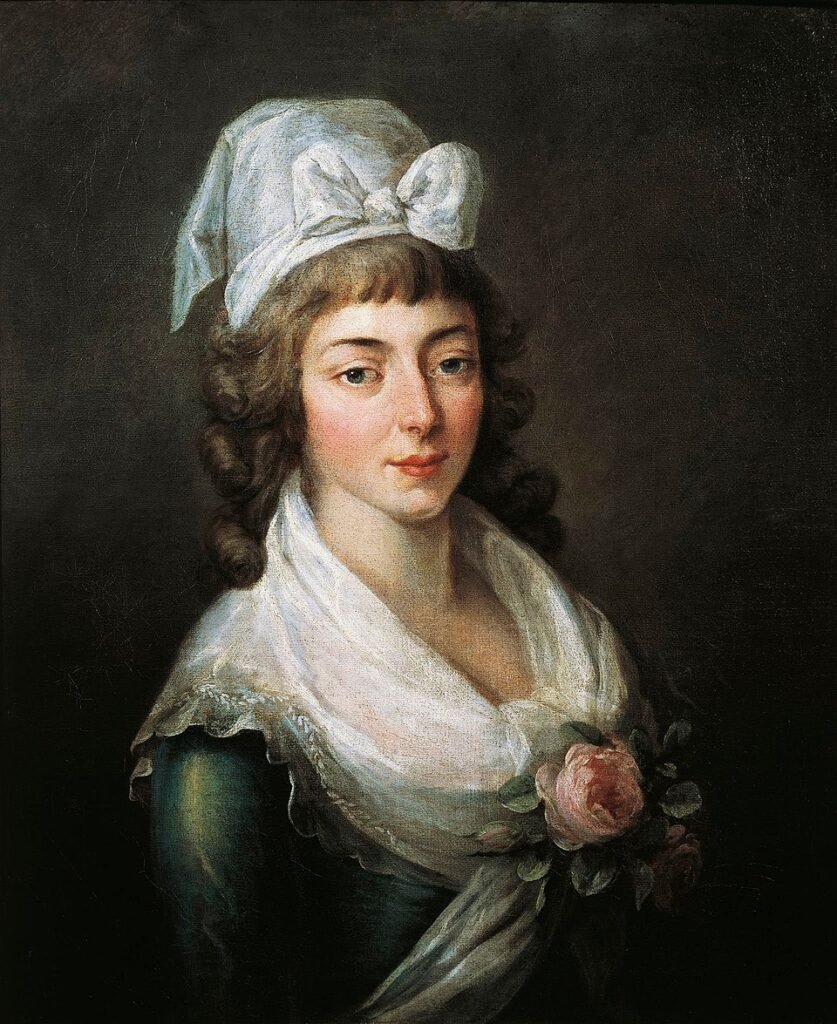
A background to one of the most influential Parisian salonnières of the French Revolution – Madame, or Manon Roland
During my research of Lyon in the French Revolution, I came across the name Manon Roland. Madame Roland (known by her nickname Manon) and her husband Jean-Marie Roland de la Platière were significant, leading figures of the Revolution both in Lyon and in Paris in the early years.
Although Jean-Marie was the politician, it was Manon who pulled the strings. She was a huge advocate of the Enlightenment and found the provincial lifestyle of Lyon claustrophobic, so the couple moved to Paris where she became a famous salonnière, inviting all the leading revolutionary men of the time to her salon to discuss politics and ideas. However, despite her active involvement in the Revolution, she was a product of the patriarchy that she grew up in and maintained that politics was a man’s world. She therefore remained intentionally in the shadow of her husband, allowing him to take the limelight, even if she was probably responsible for the penmanship behind many of her husband’s political speeches.
Manon Roland and the French Revolution
Manon Roland also wrote extensively under her own name, including articles for the Paris newspapers. In order to get a greater grasp of the Lyonnais story of the Revolution, I decided to read The Memoirs of Manon Roland and I implore you to read them too. She wrote her memoirs during her 6 months imprisonment as she awaited her execution at the guillotine. Considering how staunchly patriotic and in favour of the revolutionary movement Manon was, her execution was perhaps one of the single most poignant examples of the contradictions of the French Revolution, and a stark reminder how paranoia and conspiracies can destroy both whole movements and individual lives. Manon Roland was a true patriot, including being decidedly anti-royalist but she did not agree with the methodology of the Jacobins and the sans-culottes. This is ultimately what led to her being guillotined in June 1793.
The Memoirs of Madame Roland
Because the Rolands spent so much time in Paris, Manon Roland’s memoirs did not give me as much information on the Lyonnais Revolution as I had hoped. However, her private memoirs, which you can read here gave a fascinating background to her early life and childhood. In many ways, the character of Alphonsine is inspired by her; hence why Alphonsine admires Mme Roland so much in The Power of the Wouivre: Revolution.
The rest of her memoirs provide a rare insight into some of the leading political figures of the time who were frequent visitors to her Parisian salon, until they turned against her. Her lack of feminism is probably the only thing stopping her from becoming, in contemporary annals, the most influential woman of the French Revolution, which is ironic considering her opinion on the men of her club (see below). So, I wanted to finish here with a series of quotes from Manon’s own hand regarding the opposing leaders of the Girondin and Montagne parties who visited her salon. I hope you find them as fascinating as I did.
Men of Madame Roland’s salon
“What struck me most and distressed me exceedingly, was that sort of light and frivolous chit chat, in which men of sense pass three or four hours without coming to any conclusion”
ON BRISSOT: “simple manners […] frankness […] austerity of principles”; “levity of mind”; “enemies never failed to take advantage”; “Best of men. A good husband, an affectionate father, a faithful friend […] of hatred he is incapable”; “I have seen him dedicating his whole time to the revolution, for no other end than to forward the triumph of truth, and promote the welfare of the public”
ON ROBESPIERRE: “at that time [1791] Robespierre had to me the semblance of an honest man, and for the sake of his principles I forgave the defects of his language and his tiresome way of speaking”; “he was always reserved in these committees, hearing the opinion of all and seldom giving his own”; “he was the first to mount the tribune, and to avail himself of the arguments which the evening before he had heard delivered by his friends”; “Persuaded at that time that Robespierre was passionately fond of liberty, I was inclined to attribute his faults to an excess of fiery zeal”; “Never did the smile of confidence rest on the lips of Robespierre, while they were almost always contracted by the malignant grin of envy, striving to assume the features of disdain”; “But he maintained principles with warmth and perseverance, and there was some courage in continuing to do so, at a time when the defenders of the cause of the people were greatly diminished in number […] to support and encourage them was therefore the duty of a patriot. I esteemed Robespierre on this account”
ON DANTON: “To take Danton into the administration was to deluge the government with such men as I have described, who harass it, when not in employ, and corrupt and debase it, when they participate in its operation”; “No man could make a show of greater zeal, of greater desire to concure with his collegues […] and though I used to say to myself that no-one should be condemned upon hearsay […] I never saw anything that so strongly expressed the violence of brutal passions and the most astonishing audacity”; “[he] had the hardihood to avow a fortune […] to wallow in luxury, whilst preaching up sans-culottisme and to sleep on heaps of slaughtered men”